Learn how to value casino welcome bonuses like financial instruments: expected value, wagering requirements, game weighting, and bankroll discipline.

Evaluating Casino Welcome Bonuses: A Financial Guide

In the world of high finance, you are constantly looking for an edge, an arbitrage opportunity, or a mispriced asset. It is worth applying that same rigorous mindset to the online casino industry, and specifically to the welcome bonus. Most players view these offers as free money or a generous gift. You should view them differently. A welcome bonus is a structured financial product with specific liquidity constraints, volatility risks, and expected value metrics, and it deserves the same scrutiny you would give any other instrument before committing capital.
When you approach a casino welcome bonus, you are essentially engaging in a transaction where the operator provides capital in exchange for volume. Your goal is to manage that capital through a high-risk environment and extract a profit on the other side. This is not gambling in the traditional sense; it is a mathematical exercise in risk management and probability. The operator has priced the offer to acquire you as a customer. Your job is to work out whether the price they are paying exceeds the cost you will incur to collect it.
By stripping away the flashing lights and the marketing gloss, you uncover a contract governed by probability and terms of service. Understanding that contract is the only way to determine whether an offer represents a viable investment of your time and capital or a negative-sum game best avoided. This guide walks through the full valuation framework: the categories of offers on the market, the mathematics of wagering requirements, the fine print that governs liquidity, and the bankroll discipline that holds the whole strategy together. It also grounds the theory in offers operators are actually publishing, so you can see how the framework applies to real terms rather than hypotheticals.
Key Takeaways
- A profitable casino welcome bonus strategy relies on calculating Expected Value (EV) to ensure the offer is mathematically positive before playing.
- Wagering requirements significantly impact value, especially depending on whether the multiplier applies to just the bonus or the combined deposit and bonus sum.
- You must account for game weighting rates, as low-house-edge games often contribute less toward clearing a casino welcome bonus than slots.
- Deposit match offers function as leverage for your bankroll, while no-deposit credits provide a low-risk mechanism to test platforms.
- Always review the fine print for maximum cashout limits and expiration dates that can restrict the liquidity and potential upside of your winnings.
- Published offers differ meaningfully across markets and even across listings for the same brand, so verify the live terms on the operator’s own site before you deposit.
Deconstructing the Value Proposition of Sign-Up Offers
At its core, a sign-up offer is a customer acquisition cost for the casino and a potential return on investment for you. The casino is willing to take a short-term loss, or reduce its margins significantly, to bring you into its ecosystem. From your perspective, the value proposition hinges on the concept of Expected Value. You are looking for a situation where the mathematical probability of profit, after accounting for every variable, remains positive.
These offers behave like complex derivatives. On the surface, the yield looks extraordinary, often presented as a 100% or 200% return on your initial deposit. But, just like a high-yield bond with underlying structural risks, the true value is hidden in the details. The face value of the bonus is meaningless without factoring in the cost to unlock it: the required turnover, the house edge you will grind through, the games you are permitted to play, and the clock you are playing against.
You must look past the headline number. A smaller bonus with favorable terms often holds significantly higher equity than a massive figure attached to restrictive conditions. Your objective is to identify offers where the casino’s statistical edge is temporarily neutralized or reversed by the sheer size of the incentive, allowing you to operate with a mathematical advantage. That situation does exist, but it never announces itself. You have to find it in the terms.
Primary Categories of Welcome Incentives
To navigate this sector effectively, you need to categorize the instruments available to you. Marketing teams invent creative names, but most welcome incentives fall into a small set of distinct asset classes, each with its own risk profile and capital requirements.
Deposit Match Percentages and Caps
The deposit match is the most common instrument you will encounter, and it functions as a leverage tool. The casino matches a percentage of your deposit, multiplying your starting bankroll. For instance, a 100% match up to $1,000 means you deposit $1,000 and play with $2,000. In financial terms, this reduces your effective risk on each wager. If the casino holds a 5% edge, playing with a doubled bankroll allows you to weather variance that would otherwise deplete your principal.
You should pay close attention to the cap, which acts as the ceiling for your potential leverage. A high percentage match with a low cap might not provide enough depth for a serious strategy, whereas a lower percentage with a high cap offers more room to maneuver significant capital. The match percentage is the marketing headline; the cap and the attached wagering terms are where the actual valuation happens.
No-Deposit Credits and Risk-Free Spins
Alternatively, you have the no-deposit bonus. The casino provides a small amount of capital or a set number of spins at zero financial risk to you. While the monetary value is typically lower than a deposit match, the return on investment is theoretically infinite because your cost basis is zero. These offers serve as excellent low-risk entry points to test a platform’s liquidity, payment processing, and interface before you commit real capital.
But no-deposit credits usually come with stricter withdrawal limits, which act as a cap on your upside potential. You should view them not as wealth-building vehicles but as low-friction mechanisms to assess an operator’s reliability without exposing your own balance sheet. Run the small experiment first; scale in only if the platform passes.
Bonus Spins, Lossback, and Hybrid Structures
A growing share of published offers is built around spins rather than a cash match. According to Bonus.com’s welcome bonus rankings for July 2026, DraftKings keeps its offer simple: new players get 1,000 Flex Spins on a choice of more than 100 slots, with no promo code required. Spin packages carry an implied monetary value that you should translate into cash terms before comparing them against a match; PlayUSA’s August 2026 list, for example, notes that FanDuel’s bonus spins are valued at $0.20 each.
Lossback is a different instrument again: instead of front-loading capital, the operator refunds a portion of net losses over an introductory window. PlayUSA’s same August 2026 list shows DraftKings at up to $1,000 lossback plus 500 bonus spins, with 1x wagering and a 7-day window. And some operators bundle structures together; Sportsbook Review’s sign-up bonus table lists BetMGM Casino at a 100% Deposit Match up to $1,000 plus a $25 No Deposit Bonus, pairing leverage with a zero-cost tester in a single package. Each component of a hybrid offer should be valued separately, on its own terms.
What Operators Are Publishing Right Now
Valuation frameworks are only useful when applied to live data. The offers below are drawn from operator pages and published industry listings, with their publication dates noted, and they illustrate how widely structures vary across brands and jurisdictions. Treat them as market color rather than recommendations: availability and eligibility depend on your jurisdiction, and terms change without notice.
United States: Large Matches and Spin Packages
Operator-published pages are the most direct evidence of current pricing. BetMGM’s own promotions page for September 2026 advertises a 100% Deposit Match up to $2,500, plus an extra $50 on the house and 50 Bonus Spins. That is a headline figure at the top end of the published market, and precisely the kind of offer whose fine print deserves the closest reading.
Aggregator listings often surface the terms alongside the headline. According to GamingToday’s casino bonus roundup, Caesars Palace Casino offers a 100% first deposit bonus of up to $2,500, plus 2,500 Reward Credits after you wager at least $25, and the bonus carries a 15x playthrough requirement on slots. That last detail is exactly the variable your valuation model needs, and it is the piece most marketing pages omit.
LegalSportsReport’s September 2026 listings show FanDuel Casino at deposit $5, get 500 Bonus Spins and $50 in Casino Bonus, while PlayUSA’s August 2026 table lists FanDuel at deposit $10, get $40 in casino credits plus 500 bonus spins at 1x wagering, and Bet365 at a 100% deposit match up to $1,000. Sportsbook Review’s table adds Golden Nugget at bet $5, get 500 Flex Spins.
Notice that BetMGM’s own page and Sportsbook Review’s table publish different match caps for the same brand, and that DraftKings appears with a spins-only structure in Bonus.com’s ranking but a lossback structure in PlayUSA’s. Published listings are snapshots taken at different times under different terms. Treat every list as provisional market data and confirm the live offer on the operator’s site before you deposit.
United Kingdom: Smaller Matches and Spin-Heavy Offers
The UK market prices differently. Casino.org’s UK bonus list for March 2026 shows Jackpot City Casino at a 100% match up to £100 plus 100 free spins, Casumo at a 50% match up to £50, and Fun Casino offering 100 free spins with no wagering attached. Racing Post’s UK welcome bonus table for September 2026 lists LuckyMate with 250 bonus spins on Big Bass Splash, BetMGM with 225 free spins on Big Bass Splash, and Paddy Power with 260 free spins.
The published UK offers lean heavily on free spins and carry far smaller match caps than the US listings above. That shifts the valuation question: with spin-based offers, the analysis moves from turnover mathematics to the implied value of the spins, the games they are locked to, and the withdrawal terms attached to whatever they return. A no-wagering spin package can be worth more in practice than a nominally larger bonus buried under a heavy playthrough multiplier.
The Mathematics of Wagering Requirements
The wagering requirement is the most critical variable in your valuation model. It dictates the volume of turnover required before bonus funds convert from restricted credits into liquid cash. Without understanding this, you are flying blind, and no headline figure can save you.
Understanding Playthrough Multipliers
The playthrough multiplier represents the velocity of money required by the contract. If you receive a $1,000 bonus with a 20x wagering requirement, you must place $20,000 worth of bets. This is your hurdle rate. Every dollar of that turnover passes through the house edge, so the multiplier is not an administrative detail: it is the primary driver of your expected cost.
You must scrutinize whether the multiplier applies to just the bonus amount or to the combined sum of the deposit and bonus. A 30x requirement on the bonus alone is significantly more favorable than a 30x requirement on the total available funds. The difference between these structures can single-handedly flip a positive EV opportunity into a negative sum. Calculate the total required handle in dollars, then ask whether your bankroll can sustain the variance over that volume of play.
Calculating Expected Value
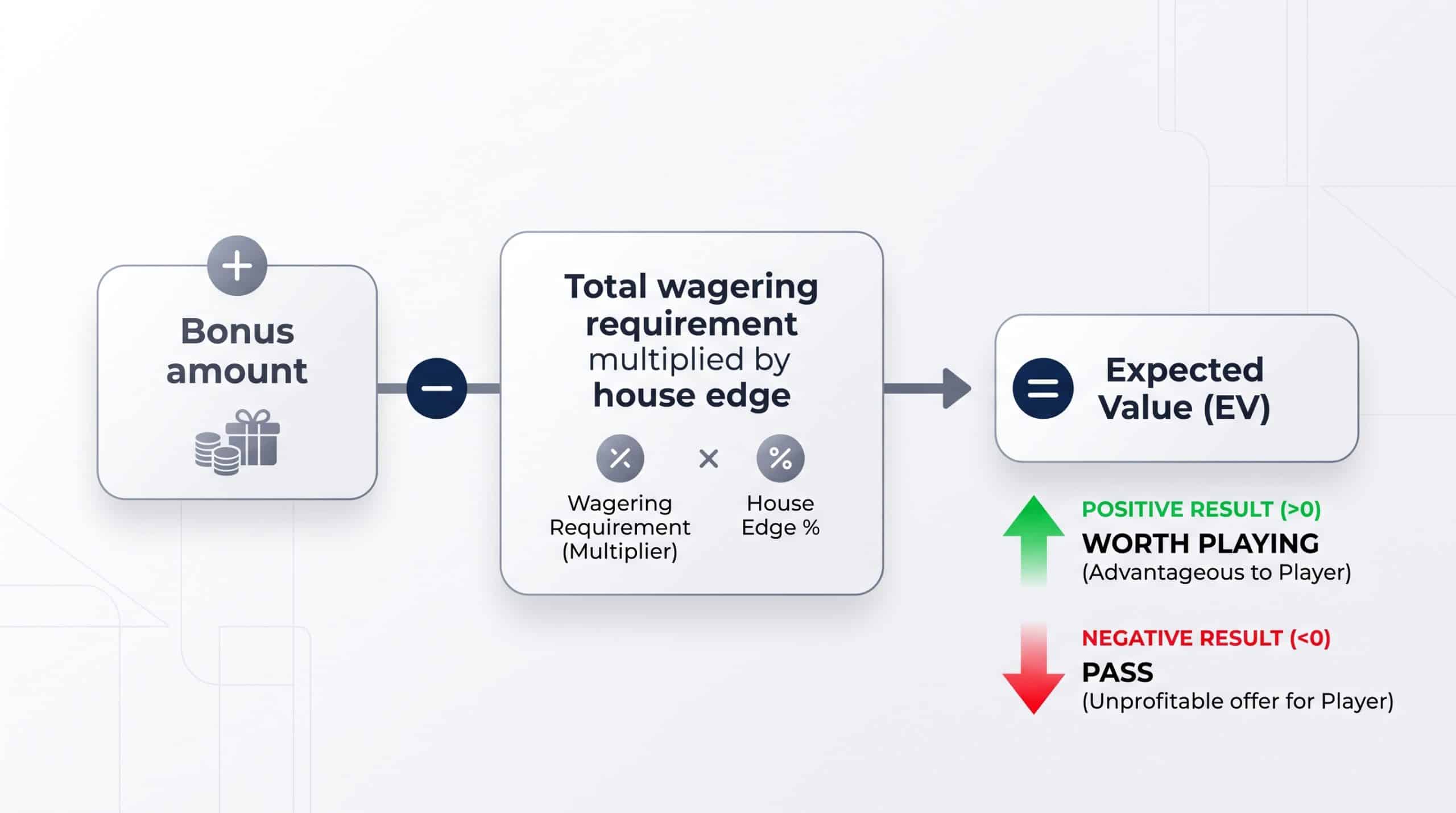
To determine the true worth of a bonus, run the Expected Value formula. Take the total bonus amount and subtract the estimated loss incurred while meeting the wagering requirements. The estimated loss is the total wagering requirement multiplied by the house edge of the game you intend to play.
For example, if you must wager $10,000 on a game with a 1% house edge, your expected loss is $100. If the bonus was $500, your Expected Value is $400, a clearly positive play. But if you are forced onto a game with a 5% house edge, the expected loss rises to $500, rendering the same bonus break-even. You should only engage with offers where this final calculation yields a positive number, ensuring the probability of profit is in your favor before you place the first bet.
Reading Published Terms Through This Lens
Apply the framework to the published terms above. GamingToday reports a 15x playthrough requirement on slots for the Caesars Palace Casino deposit bonus; that multiplier is the hurdle rate you would run against the house edge of the specific slots you intend to use. At the other extreme, PlayUSA’s August 2026 list shows 1x wagering on both the DraftKings lossback offer and the FanDuel credits-and-spins package; a lower multiplier means less required turnover, which shrinks the expected-loss term in your calculation. And per Casino.org’s UK list, Fun Casino’s 100 free spins carry no wagering at all, which removes the hurdle entirely for whatever the spins return. None of this replaces reading the full terms yourself, but the published multiplier is your fastest go/no-go filter.
Terms and Conditions Affecting Liquidity
Beyond the raw math, the terms and conditions act as the regulatory framework of the agreement. These clauses directly impact the liquidity of your capital and can trap your funds if you are not careful. Ignoring the fine print is akin to signing a contract without reading the covenants.
Game Weighting and Contribution Rates
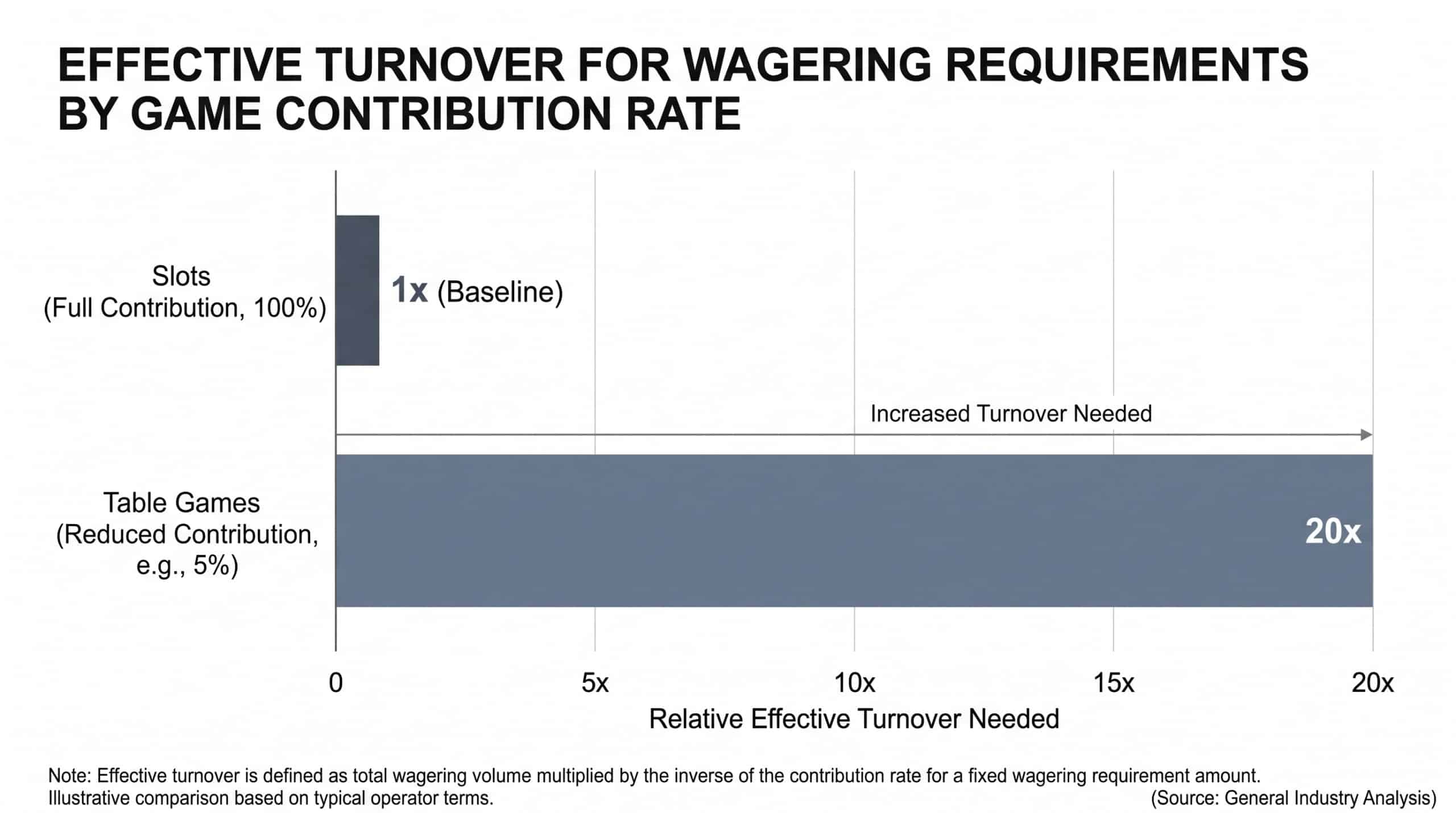
Not all asset classes are treated equally inside a casino. Operators know that games like Blackjack and Baccarat carry a low house edge, so they often downgrade those games’ contribution toward the wagering requirement. This is game weighting. While a slot machine might contribute 100% of every dollar bet toward the requirement, Blackjack might contribute only 10%, or nothing at all.
The consequences compound quickly. If you plan to grind through a $20,000 requirement playing Blackjack at a 10% contribution rate, your effective wagering requirement just increased tenfold to $200,000. You must verify that the games offering the best statistical odds are not excluded or severely handicapped by the weighting scale. In practice it becomes a balancing act between a high-variance game that contributes 100% and a low-variance game that demands tenfold the volume. The optimal choice depends on your bankroll depth and the time you have available, not on which game you happen to enjoy.
Withdrawal Limits and Expiration Dates
Liquidity risk also manifests through withdrawal limits and time horizons. Some bonuses impose a maximum cashout rule, capping your winnings regardless of your success. If you turn a $100 bonus into $5,000 but the max cashout is $500, the remaining $4,500 is forfeited. A cap like that severely dampens the upside that makes a volatile position worth holding, and it is disclosed only in the fine print.
Expiration dates create the same pressure on the other axis. You might have as little as seven days to clear a large wagering requirement, and real offers do publish tight windows: PlayUSA’s listing attaches a 7-day window to the DraftKings lossback structure. A short clock forces you to increase your volume or your bet size, potentially pushing you outside your standard risk parameters. You need a time horizon that permits a disciplined approach rather than a frantic rush that produces errors.
Strategic Allocation and Bankroll Management
Once you have identified a positive EV opportunity, you must execute with precision. This requires strict bankroll management, similar to running a portfolio of volatile assets. Never commit capital you cannot afford to lose: short-term variance can destroy even a mathematically advantageous position, and the edge only materializes over sufficient volume.
The concept of Risk of Ruin becomes paramount here. Size your bets relative to your total bankroll so that you can survive a downswing long enough to realize the long-term edge. Treat the deposit and the bonus as a segregated fund, and do not mix it with your main operating capital until the wagering requirements are cleared. Compartmentalizing the funds maintains a psychological distance that supports rational decision-making under variance.
If you hit a losing streak, trust the math. If you hit a winning streak, resist the urge to raise your stakes aggressively because you feel lucky. Stick to the predetermined bet size that aligns with your timeline, the contribution rate of your chosen game, and its volatility profile. Discipline is the only thing standing between you and the casino’s edge, and it costs nothing to maintain.
A Repeatable Evaluation Checklist
Before committing capital to any welcome offer, run the same sequence every time:
- Confirm the playthrough multiplier and, critically, whether it applies to the bonus alone or to the combined deposit and bonus.
- Convert the multiplier into total required turnover in cash terms.
- Check the game weighting table and identify which eligible game gives you the best blend of contribution rate and house edge.
- Compute Expected Value: bonus amount minus expected loss across the full required turnover.
- Locate the maximum cashout clause and the expiration window, and discard offers whose caps or clocks undermine the position.
- Size your bets against your segregated bankroll so that Risk of Ruin stays acceptable for the required volume.
- Verify the live terms on the operator’s own site, since aggregator listings and even operator marketing pages go stale.
Conclusion
Successfully navigating the casino welcome bonus requires you to suppress the gambler’s impulse and elevate the analyst’s logic. These offers are not gifts. They are complex financial instruments that require deconstruction, valuation, and disciplined execution. By understanding the interplay between wagering requirements, game weighting, withdrawal limits, and expected value, you can turn a marketing expense for the casino into a profit center for yourself.
The published market shows just how much dispersion exists between offers: large deposit matches with heavy playthrough on some listings, low-multiplier lossback and no-wagering spins on others. The goal is not simply to play, but to execute a strategy that yields a positive return on capital. Treat every bonus as a business transaction, read the fine print as you would a prospectus, and trust the mathematics over the emotion.
Frequently Asked Questions
What is a casino welcome bonus in financial terms?
A casino welcome bonus is best viewed as a structured financial product rather than free money. It is a contract where the operator provides capital in exchange for betting volume. Your objective is to manage this capital through wagering requirements to achieve a positive Expected Value and extract profit.
How do wagering requirements impact the value of a bonus?
Wagering requirements dictate the total turnover required to convert restricted credits into liquid cash. For example, a 20x multiplier on a $1,000 bonus requires $20,000 in bets. You must determine whether the multiplier applies to just the bonus or to the combined deposit and bonus, as this significantly alters the risk profile.
How can I calculate the Expected Value of a sign-up offer?
Subtract the estimated loss during wagering from the total bonus amount. Multiply the total wagering requirement by the house edge of your chosen game to find the estimated loss. If the remaining figure is positive, the casino welcome bonus offers a statistical advantage; if it is negative, decline the offer.
Can I withdraw a casino welcome bonus immediately?
No, you generally cannot withdraw a casino welcome bonus immediately. Most offers lock your funds in a restricted state until you satisfy the specific wagering requirements and terms of service. Attempting to withdraw early often results in the forfeiture of both the bonus funds and any accumulated winnings, though some published offers do carry no wagering on spin winnings.
What is game weighting and how does it affect my strategy?
Game weighting reduces the contribution of low-house-edge games, like Blackjack, toward meeting wagering requirements. While slots often contribute 100%, table games might contribute only 10%. This effectively multiplies the volume of play required, forcing you to balance asset selection between high-contribution slots and low-variance table games.
What is the difference between a sticky and a non-sticky bonus?
A non-sticky (or parachute) bonus allows you to play with your cash deposit first and withdraw winnings before touching the bonus funds. A sticky bonus merges your deposit and bonus immediately, locking your liquidity until wagering requirements are met. Non-sticky offers generally present lower risk to your principal.